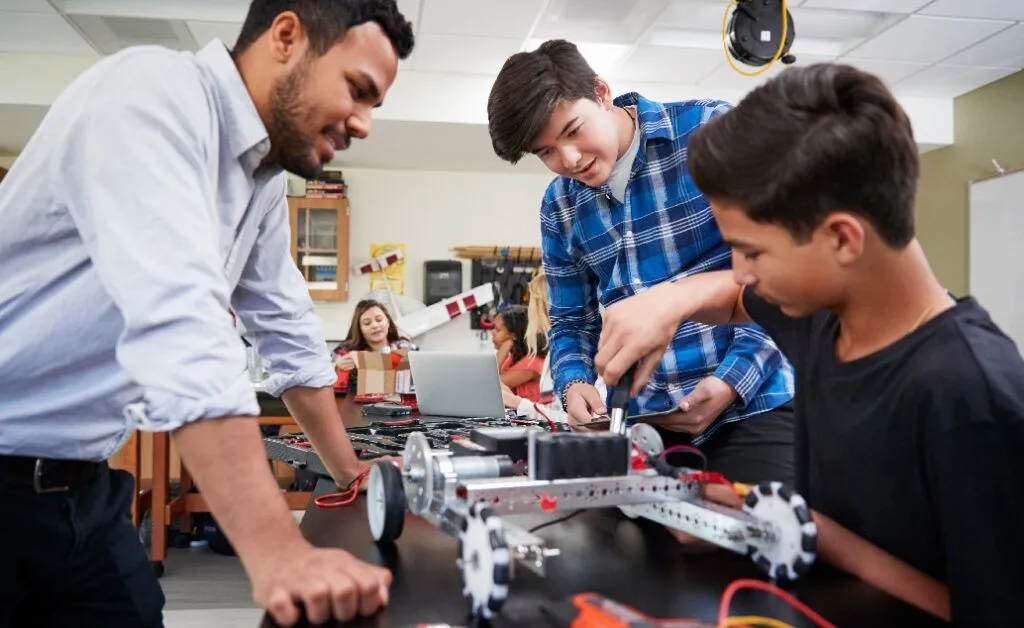
The global economy is undergoing a massive structural transformation driven by artificial intelligence, automated systems, advanced biotechnologies, and the worldwide transition to renewable energy. At the core of this monumental shift lies STEM education, an integrated pedagogical model combining science, technology, engineering, and mathematics.
Historically, these disciplines were taught in educational silos, often reserved for specialized research laboratories or niche engineering tracks. Today, that narrow perception is obsolete. Modern STEM education is not merely a collection of isolated subjects; it represents a foundational methodology for cognitive development, empirical reasoning, and interdisciplinary problem-solving.
As enterprises navigate cross-border competition, resource constraints, and unprecedented digital expansion, the demand for STEM-literate professionals has moved well beyond technical firms. From international finance and environmental policy to modern agriculture and creative media, STEM-trained thinkers are establishing the operational standard for twenty-first-century global leadership.
Driving International Economic Growth and Workforce Resilience
National prosperity and technological sovereignty are directly linked to the strength of a country’s scientific and technical human capital. Countries that invest heavily in STEM curricula build agile, future-proof workforces capable of launching high-growth industries and attracting foreign investment.
Rapid Growth in Emerging Job Markets
The international labor market shows a clear divergence between traditional clerical occupations and science-driven careers. Employment across STEM occupations consistently expands at several times the rate of non-STEM fields. Areas experiencing sustained global shortages include:
-
Cloud Infrastructure and Cyber Defense: Protecting distributed data centers, enterprise networks, and national critical infrastructure against sophisticated digital threats.
-
Biomedical Engineering and Precision Health: Developing targeted gene therapies, synthetic organs, and advanced pharmaceutical production lines to address global health crises.
-
Clean Energy Systems: Designing smart power grids, next-generation energy storage, and industrial-scale carbon capture technology to meet net-zero carbon mandates.
-
Automated Supply Chain Architecture: Utilizing algorithmic modeling to stabilize global distribution channels, maritime transport, and predictive logistics.
These careers do not just pay significantly above the median wage; they remain remarkably resilient during macroeconomic contractions, insulating workers from automation-driven displacement.
Fostering Decentralized Global Innovation Hubs
Decades ago, advanced technical work was concentrated within a handful of geographic hubs in North America and Western Europe. Strong investments in STEM education have leveled the global playing field.
Nations across Southeast Asia, Latin America, and Eastern Europe are producing millions of engineers, software architects, and data analysts every year. This geographic democratization of STEM expertise allows high-growth startups to launch and scale anywhere on the planet, creating interconnected, multinational innovation ecosystems.
Cultivating Core Cognitive Competencies Beyond Technical Skills
A common misconception is that STEM education benefits only those who intend to become professional coders, laboratory scientists, or civil engineers. In reality, the true strength of STEM education lies in the durable cognitive habits it instills across all academic disciplines.
Empirical Problem Solving and Hypothesis Testing
Traditional rote memorization teaches students to recall past facts, while STEM pedagogy trains students to run active experiments. Learners evaluate ambiguous situations by breaking problems into component variables, developing hypotheses, testing assumptions, and analyzing discrepancies between expected and actual results.
This empirical mindset transforms business operations. An executive trained in scientific methodology approaches a corporate restructuring or product rollout with analytical discipline, relying on controlled data iterations rather than instinct or corporate politics.
Cultivating Algorithmic and Computational Thinking
Computational thinking goes beyond writing lines of software code; it is the ability to deconstruct complex, multifaceted systems into clear, sequential steps.
-
Pattern Recognition: Identifying underlying trends across noisy, unstructured data sets to anticipate market shifts.
-
Abstraction: Stripping away irrelevant operational details to isolate the core mechanism causing an organizational issue.
-
Logic Sequencing: Constructing scalable workflows that eliminate administrative bottlenecks and human error.
These capabilities are just as essential for legal professionals reviewing corporate mergers and public health officials managing viral outbreaks as they are for computer scientists.
Expanding Into Cross-Disciplinary and Non-Traditional Careers
The influence of STEM education has expanded into non-technical industries. As business analytics, automation, and empirical tracking become standard across the global marketplace, unconventional fields actively recruit STEM graduates to lead operational teams.
Quantitative Modern Finance and Algorithmic Trading
Modern capital markets run on high-performance algorithms, quantitative econometric models, and real-time statistical processing. Investment banks, venture capital funds, and sovereign wealth institutions routinely recruit physics, mathematics, and engineering graduates. Their advanced mathematical training equips them to price complex derivative contracts, assess portfolio risk, and evaluate technical debt in emerging technology ventures.
Data-Driven Creative Industries and Media Production
The entertainment and digital media industries are increasingly governed by computational architecture. High-budget film production relies on computational fluid dynamics and procedural modeling to generate hyper-realistic visual effects.
Streaming platforms and digital news syndicates rely on machine learning engineers to structure content recommendation algorithms and target user engagement. Even video game design is now an intersection of spatial mathematics, mechanical engineering, cognitive psychology, and artistic storytelling.
Precision Agriculture and Sustainable Food Systems
Feeding an expanding global population requires replacing legacy farming techniques with scientific systems. Precision agriculture integrates IoT soil sensors, satellite imaging, drone delivery, and genetic crop modification to maximize crop yields while minimizing freshwater and pesticide consumption. Agricultural careers now require deep expertise in environmental chemistry, robotics, and spatial data analytics.
Addressing Structural Inequities and the Global Skills Shortage
Despite clear benefits, the full potential of STEM education is often constrained by systemic barriers. Deep demographic disparities, unequal educational funding, and instructional gaps continue to limit access to technical fields worldwide.
Bridging the Gender and Socioeconomic Divide
Historically, women and individuals from lower-income backgrounds have faced implicit biases and unequal access to advanced mathematics and computer science courses. This exclusion limits personal economic mobility and deprives the global economy of vital talent.
Progressive educational initiatives are actively working to correct this imbalance:
-
Early Hands-On Exposure: Introducing robotics, coding, and maker spaces during primary school builds foundational technical confidence before societal biases take root.
-
Visibility and Mentorship: Connecting young women and underrepresented students with working professionals demystifies career pathways and counters imposter syndrome.
-
Open-Access Digital Curricula: High-quality digital learning platforms provide students in under-resourced districts worldwide with access to university-level STEM instruction.
Creating an inclusive talent pipeline is an economic necessity. Diverse technical teams design more equitable products, avoid algorithmic bias in artificial intelligence models, and solve broader societal challenges.
Integrating the Arts Through the STEAM Movement
Educators and industry leaders increasingly recognize that technical rigor without human-centered design can yield cold, counterproductive outcomes. This realization has sparked the transition from pure STEM to STEAM, incorporating the arts, humanities, and design.
Creative expression and humanistic analysis prevent ethical blind spots in technological development. A biotechnologist developing gene-editing tools must understand bioethics; a robotics engineer designing automated medical devices must understand intuitive user interfaces and human ergonomics. Infusing the humanities into technical curricula produces professionals who build technology that enhances human well-being.
Preparing the Workforce for an Accelerated Technological Future
The rapid rise of machine learning, automated analytics, and intelligent systems has sparked debate over the future of human labor. Rather than eliminating the need for human expertise, automation shifts the focus toward higher-order strategic capabilities.
Static, manual procedural skills are easily automated, but the ability to conceptualize complex architectures, oversee ethical data governance, and synthesize insights across diverse scientific disciplines remains distinctly human.
By prioritizing curiosity, quantitative rigor, and continuous iteration, STEM education provides the ultimate toolkit for lifelong professional relevance. It ensures that the global workforce can adapt to new breakthroughs and shape the course of technological innovation.
Frequently Asked Questions
What differentiates traditional science and math education from modern STEM education?
Traditional science and math instruction historically treated each discipline as an isolated subject, focusing on rote memorization, repetitive formulas, and textbook drills. Modern STEM education is an integrated, hands-on instructional framework that merges science, technology, engineering, and mathematics around project-based, real-world problems.
Do all STEM careers require an advanced four-year university degree?
No, many rewarding STEM careers do not require a bachelor’s degree. Middle-skill STEM positions, such as industrial robotics technicians, medical diagnostic equipment operators, CAD drafters, and network support specialists, require targeted two-year associate degrees, vocational apprenticeships, or specialized industry certifications, while providing strong, family-sustaining wages.
How does early childhood STEM exposure influence future career choices?
Early exposure through tactile building sets, simple coding games, and guided nature exploration helps young children develop spatial reasoning and a natural comfort with trial and error. This early familiarization prevents math anxiety, builds self-confidence, and significantly increases the likelihood that students will elect advanced science courses in high school and college.
Why are global corporations seeking STEM graduates for non-technical management roles?
Corporations value the rigorous, evidence-based mindset that STEM disciplines cultivate. STEM graduates excel at structured analysis, root-cause diagnosis, quantitative metrics, and systems thinking, making them uniquely equipped to streamline supply chains, manage capital budgets, and resolve complex organizational inefficiencies.
What is the primary difference between STEM and STEAM educational models?
While STEM focuses exclusively on science, technology, engineering, and mathematics, the STEAM framework integrates the arts, design principles, and the humanities. This deliberate inclusion helps students develop aesthetic appreciation, human-centered design skills, creative communication, and ethical reasoning alongside technical expertise.
How can developing countries expand their STEM pipelines with limited infrastructure?
Developing countries can expand STEM engagement by investing in open-source educational software, building community maker spaces using recycled components, utilizing mobile-based interactive learning, and training educators in low-cost, inquiry-based laboratory experiments that require common household materials rather than expensive laboratory equipment.
Will the rapid rise of automated tools make learning technical skills irrelevant?
Automated platforms make learning foundational STEM principles more critical than ever. While automated systems can rapidly generate code, solve equations, and analyze datasets, human professionals must design system architectures, audit technical outputs for accuracy and bias, frame the initial investigative prompts, and make contextual, strategic decisions that software cannot replicate.